I came to Japan from Brazil on a government scholarship to study energy policy at a national graduate school.
Today, I work at a government-affiliated think tank.
Having grown up in a resource-exporting society and now working within the institutional framework of Japan — a country highly dependent on resource imports — I have come to feel that Japan’s energy debate has a distinctive character.
In Japan, energy issues are part of everyday public discourse.
T
elevision and newspapers carefully report on geopolitical developments and price fluctuations. Former senior officials, financial market specialists, and economists frequently offer their views.
Such discussions are important in that they encourage public awareness.
At the same time, however, I sometimes sense that the focus tends to remain on observable events, while opportunities to slowly understand the underlying mechanisms of the energy system itself are relatively limited.
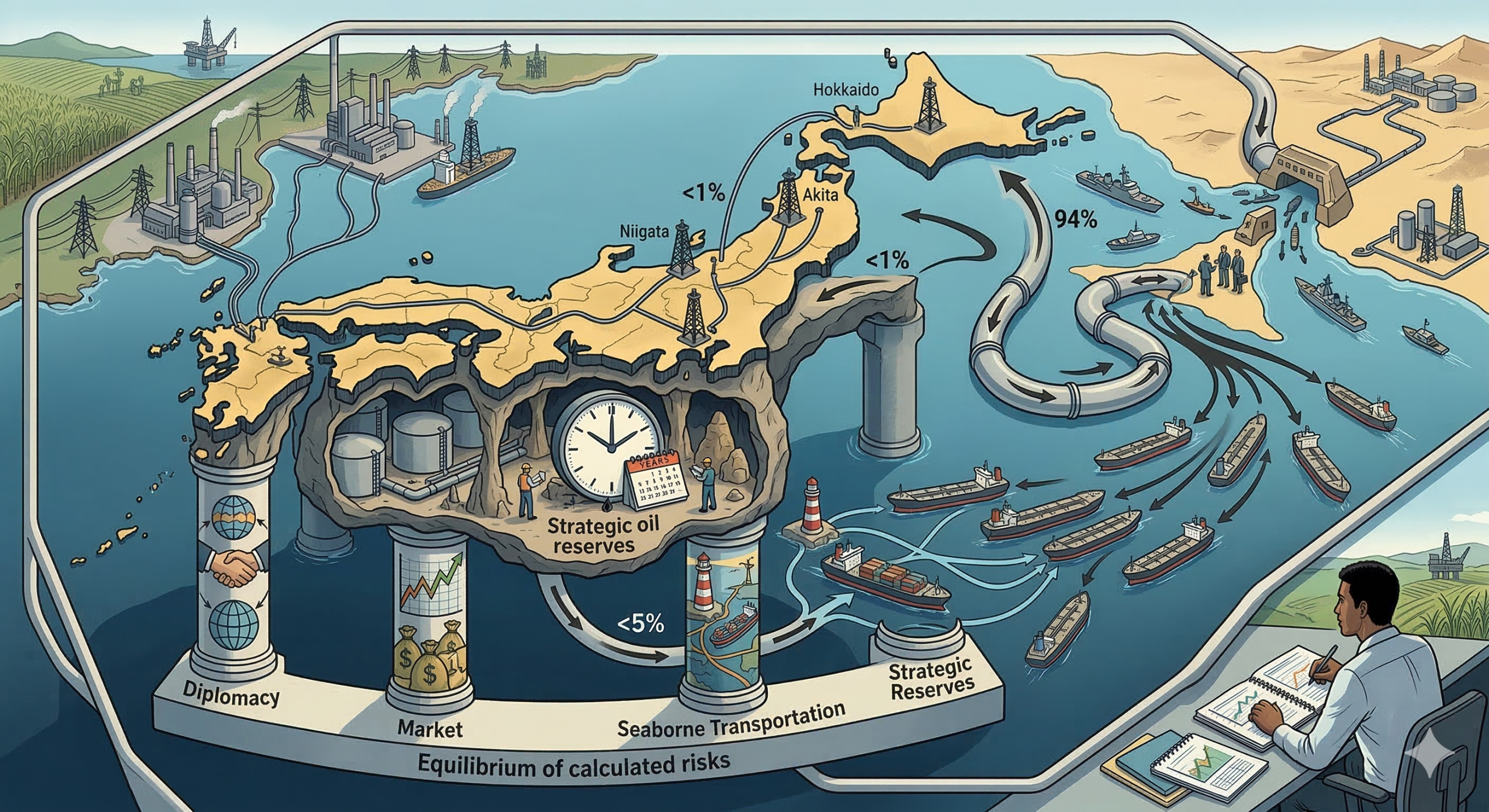
A symbolic example is the widely cited statement that “Japan imports 94 percent of its crude oil.”
This figure is accurate and serves as an important indicator of Japan’s resource constraints.

Yet the sentence alone does not fully convey the three-dimensional reality of Japan’s energy system.
Many people may naturally assume that the remaining 6 percent represents domestic production.
In reality, however, Japan’s domestic crude oil output accounts for less than 1 percent of demand.
Oil fields still exist in Niigata, Akita, and Hokkaido, but their scale is not sufficient to influence the nation’s overall energy balance.
Where, then, does this statistical gap come from?